New Wire Colors
February 6, 2025 by Brian
ElectricalIf you are having electrical work done, you will notice several different colors of wire. All wire used to have a wire jacket, then yellow was introduced. Now we have at least 7 colors. Why? Each wire has a purpose and load capacity. It is imperative that the correct wire is used. This new color system makes it foolproof.
If you look at your service panel, you will see numbers on your breakers: 15, 20, 30, 40, 50, 100, 200. etc. Each of these numbers identifies the AMPs that the circuit supports. The higher the amps, the higher the supported load. For instance, lighting is typically run on a 15 amp circuit since not much current is drawn (especially with LED bulbs). Electric ovens, on the other hand, are often 40 or 50 as they draw quite a bit of power. EV chargers are 40 or 50.
What happens when the wrong size wire is used? If the wire is too thin, it will easily overheat. Too thick is safer, but can result in a current drop which sensitive electronics will not handle well; plus it costs more money.
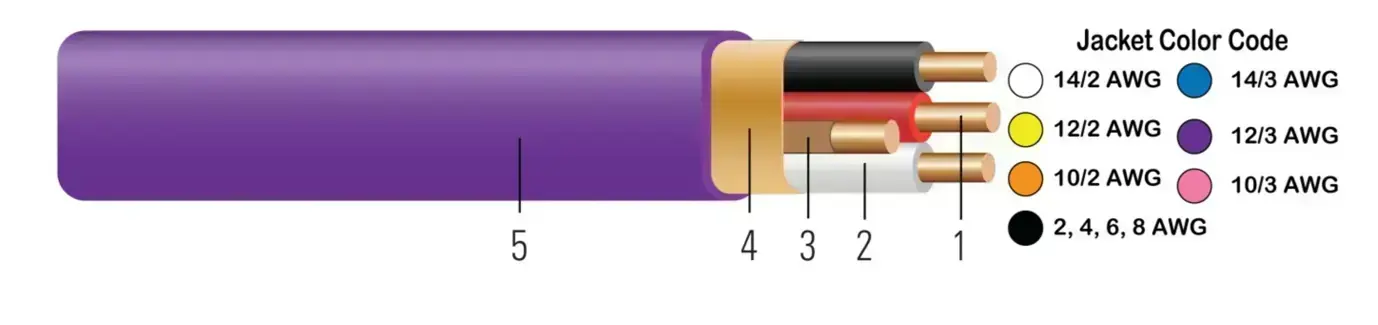
For decades, residential wire had a white jacket, then yellow was introduced. White indicates 14-gauge wire, suitable for a 15amp circuit. Yellow is used for 12-gauge and 20amp circuits. Black has indicated larger 30-plus amp circuits. So how do you know if they correct wire gauge was used? Not easily - one would have to check the end of a cable or go by "feel". Definitely inconvenient and not foolproof.
To make matters more complicated, some cable includes 4 wires instead of three. Most cable has three wires: hot / black (power feed), neutral / white (power return to complete the circuit) and ground / green or bare (a safety feature). 4-wire cables include a second hot wire (typically red and is used for 220V circuits or in special cases like a 3- or 4-way switch. But these were still white or yellow on the outside.
Starting in 2024, more colors were introduced to help this identification process. The diagram above shows the new blue, purple and pink coloring that splits 4-wire cables into their own color set. This will help a busy inspector readily identify the wiring and also help prevent mistakes from an electrician. Not to mention your walls will be more interesting during the construction process!